
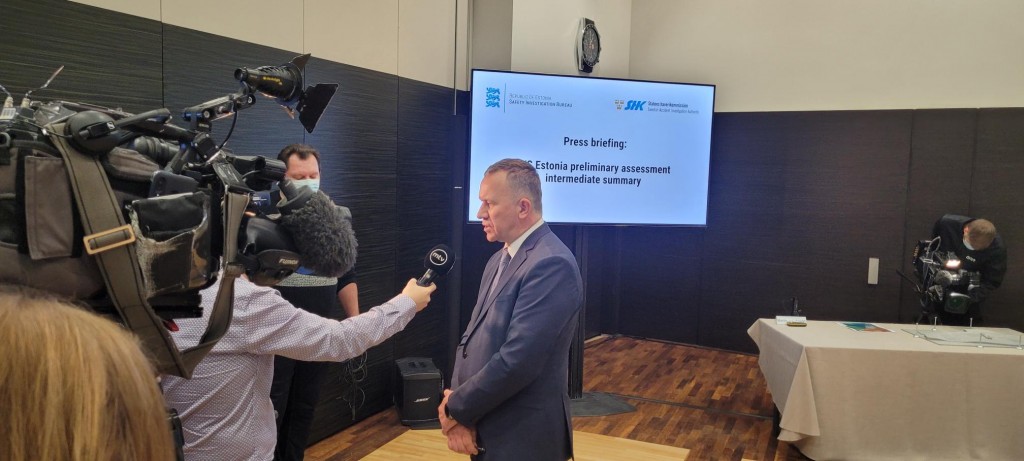
“The purpose of the preliminary assessment is to investigate the damage on the starboard side of the ship, which were first shown in 2020 in the Discovery Network film and to consider whether, in the light of the new information, the 1994 Joint Accident Investigation Commission (JAIC) findings on the cause of accident of MV Estonia should be reassessed and further investigation on the matter conducted”, says Rene Arikas, Executive Director of Estonian Safety Investigation Bureau. “Since we discovered different damage and deformations on the hull, during the pre-survey the whole wreck needs to be investigated thoroughly. There is no reason to make extensive conclusions today, but because of a very high public interest, it is necessary to examine any new matters which have occurred and we will undertake this next year.”
“MV Estonia could most likely end up being one of the most investigated shipwrecks ever,” says Jonas Bäckstrand, Deputy Director General of the Swedish Accident Investigation Authority. “Investigations as thorough as those being carried out at MV Estonia, have not taken place even at the Titanic. We have had the possibility to use world top technologies for the survey of the wreck and the surrounding seabed. The substantial and technical knowledge and experience that the safety investigation institutions and scientists have gathered in the fields of marine studies thanks to the preliminary assessment of MV Estonia, will form a valuable basis for the future.”
The next stage of the preliminary assessment includes a ferromagnetic survey, laser scans, fotogrammetry and continuation of monitoring of seafloor currents and visibility. When we have received the last missing drawings, we will start with scanning the drawings, creating a digital twin of the ship and various simulations. Interviews with the survivors of the accident are also planned to be carried out.
The geological and geophysical pre-assessment of the wreck site was carried out in the lead of Martin Jakobsson, Professor of Marine Geology and Geophysics of Stockholm University.
Tuukritööde OÜ carried out underwater robot survey at the wreck of the passenger ferry Estonia between 14 and 15 July 2021 to check the images and objects on the sonar images. Seven ROV dives took place. The videos of the underwater robot survey are available on the website.
During the pre-survey from 11th to 16th of July 3D-scanning was carried out with Kongsberg-Mesotech MS1000 scanner in cooperation with USA based 3D-scanner expert Brian Abbott. In the summary of the survey, Brian Abbott concludes: “Overall, MV Estonia appears to be enduring slow structural decay from the impact, sliding, and natural deterioration over the 27 years. While at this point in time it is indeterminable when the damage that the ship currently displays occurred, the data obtained from this preliminary assessment can be used as a reference point and building block for future studies.