
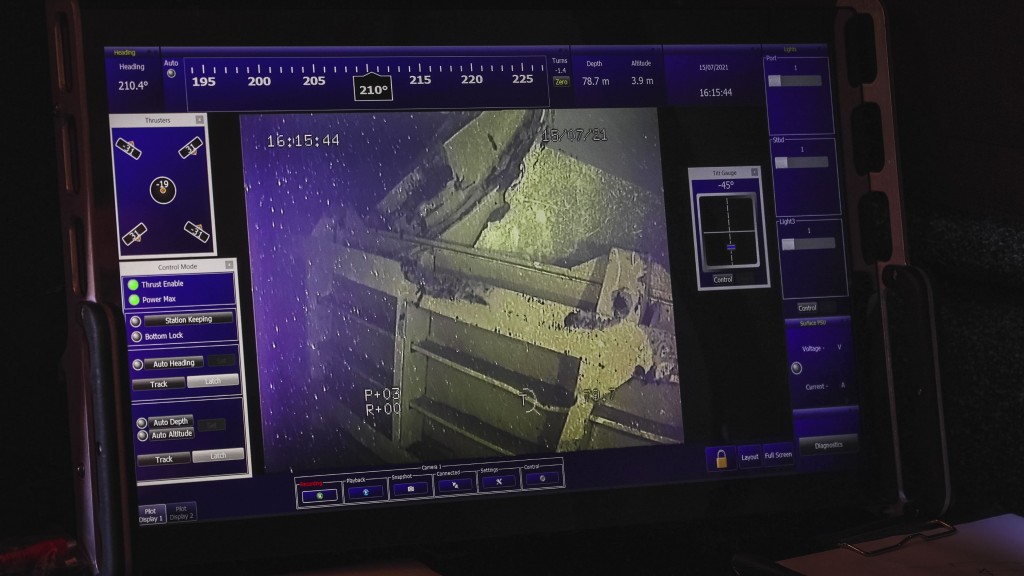
“The investigation of the wreck of MS Estonia has reached the next stage, where we are commencing the main surveys,” stated Rene Arikas, the director of the Estonian Safety Investigation Bureau. “During the preliminary assessment of MS Estonia, which started last summer, extremely thorough work and preparations have been carried out for the main surveys, which include 3D laser scanning of the wreck, a photogrammetric and ferromagnetic survey, and various simulations with the vessel’s digital twin.”
“In the course of the 3D laser scanning survey, a point cloud of the wreck and the landforms in the immediate vicinity of the wreck will be created to obtain detailed information about the wreck and the surrounding landforms,” Arikas said. “The 3D laser scanning project has been divided into four parts.”
“The first order of business is to survey the car deck, so as to obtain as detailed an overview as possible of the condition of the car deck and the objects present there. The car deck survey is highly complex in terms of technical aspects. The objective is to get the clearest possible picture of the state of the car deck, including deformations as well as openings, such as doors, vents, engine room hatches, etc., and to determine whether they are closed or open.”
The second step, according to Rene Arikas, is to conduct a survey of the wreck and the seabed, which will involve precision scanning of the wreck. “Then, the third stage of the plan is to investigate high-priority areas where external damage to the wreck has been identified during previous investigations: the bow section, including the ramp, ramp opening, locks, and hinges; damage to the starboard side and damage to the stern and port side at deck 6 level,” Arikas explained. “High-priority areas also include seabed areas, where the focus will be primarily on the line of contact between the wreck and the seabed and its immediate vicinity.”
“The fourth part of the laser scanning survey will be conducted as an additional step if, based on preliminary assessments made at sea, any area on or around the wreck proves to be of particular interest,” Arikas added.
The 3D laser scanning of MS Estonia will be carried out on VOS Sweet, a research vessel flying the Dutch flag. The survey team is an international one, as it includes experts from Estonia, Sweden, Germany, and Poland. From the Estonian Safety Investigation Bureau and the Swedish Accident Investigation Authority there will be all together three investigators to participate in the surveys. The team will be working around the clock during the surveys at sea.