
“The side-scan and multibeam sonar surveys conducted by the research vessel Electra af Askö will provide a good overview of the wreck of MV Estonia and the surrounding seafloor by yielding a 3D image, which will be needed for the subsequent main surveys,” explained Rene Arikas, director of the Estonian Safety Investigation Bureau. ‘In addition, we conducted a survey with a sub-bottom profiler, which allows us to peer down to a depth of up to 50 m below the seafloor. This survey will inform us about the geological condition of the seafloor – the locations of different types of material: moraine, clay, sand. We also performed some drilling, where we collected samples from different locations on the seafloor to verify the results of the sub-bottom profiling.’ According to Rene Arikas, similar surveys were conducted in 1995–1996, but the information obtained back then was less accurate; technology has since advanced greatly, and the data obtained this time around are much more detailed.
“On Monday, 12 July, we launched a 3D sonar survey of the area surrounding the wreck. This was an extremely complicated operation, where a 3D scanner was set down in 16 locations around the wreck to obtain a detailed image,’ Arikas stated. ‘This survey is somewhat similar to what surgeons do when performing extremely complex surgeries through a tiny hole. When you are on a moving ship at sea, it is difficult to determine exactly where the 3D scanner will land on the seafloor. Whenever our designated point on the seafloor turned out to be on a slope, we had to look for a new location. On Tuesday, we were able to start surveying the top and bottom of the wreck and the deckhouse,” Arikas said.
However, the team encountered an unexpected technical problem in the form of interference to the signal of the 3D sonar, the cause of which has yet to be identified. While the range of 3D scanner imaging should normally be 50 to 75 m, current visibility is only up to 20 m. This interference may be connected to the transmitters of the transducers of the survey vessels or to an interfering signal from an external source. Due to this, the density of the observed points needs to be increased by 3 to 4 times, which will extend the 3D sonar survey, which was initially only supposed to last 48 hours, by several days.
“Despite the obstacles, thanks to our highly professional team, we have now managed to survey the entire area along the path of the shipwreck and around the sunken ferry and to obtain a high-quality 3D image of the wreck,” Arikas reported. “We can see various signs of damage on the wreck of MV Estonia, which occurred upon impact of the vessel with the seafloor. The damage is quite extensive and it is not possible to explore every instance in detail, but we will be paying great attention to critical areas,” Arikas explained. “First and foremost, we want to find answers to questions about the damage on the starboard side: the locations and extent of the damage and whether it is just a single instance of damage or two or more. If we make any new discoveries, they will be documented in detail. We know that the wreck is lying bottom-up on the seafloor and that the damage is greatest in the stern of the vessel, where the structures are lighter and more susceptible to damage. However, the damage also extends to the middle and bow of the vessel, and the upper deck and funnel section, too, have likely suffered considerable damage,” Arikas stated.
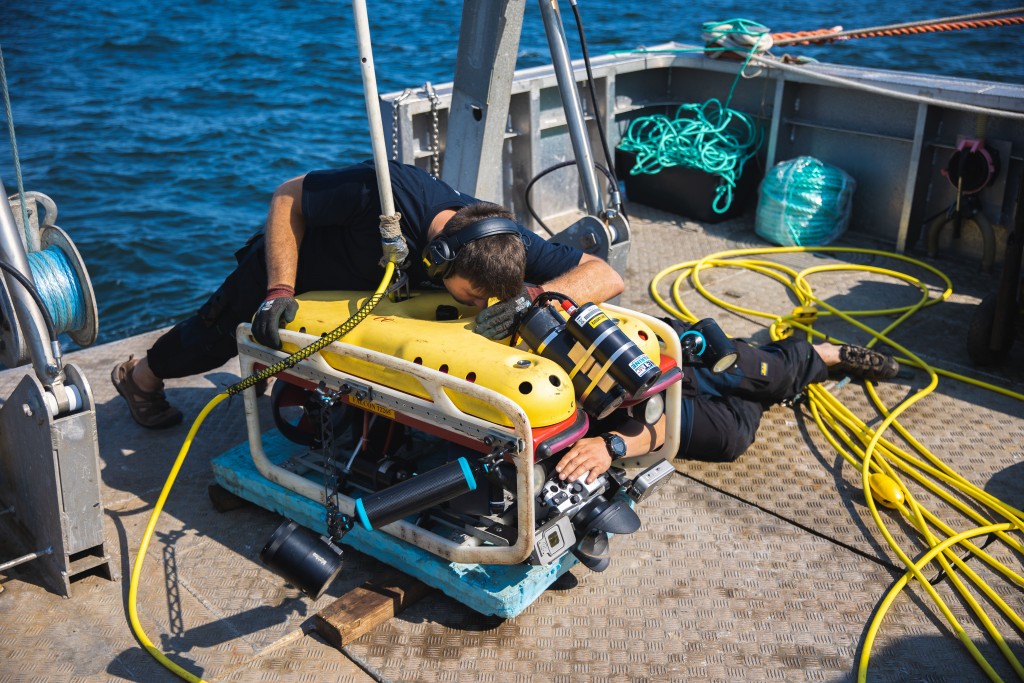
According to Arikas, there are a number of objects scattered around the wrecked vessel. “We knew from before that various objects had fallen out of the vessel. At this point, however, we cannot say for all of them whether they came from the ferry or ended up there at some other time, but we can see that these are man-made objects, not natural rocks. We know that different objects have sunk at different times and in different places in the Baltic Sea. Many of the objects there may have nothing to do with MV Estonia. They will, however, need further investigation in the future. Today, the team is planning to proceed with seafloor surveys and drilling in various locations, including to conduct an acoustic survey of the seafloor. ROV surveys are about to start too. The team will be combining two solutions: a 3D scanner and an ROV. ‘If, after we have identified deformations on the hull using one technology, we are unable to tell from the figures what precisely it is that we are dealing with, we will be deploying the ROV to conduct closer inspections and to verify whether we are looking at damage or a signal error," Arikas explained.
“Although a variety of surveys have been carried out at the MV Estonia shipwreck on multiple occasions since the sinking of the passenger ferry, modern technology and software will enable us to obtain a more detailed and accurate overview as well as to determine what happened and why,” Arikas added. “For example, the 3D scanner will allow us to identify, locate, and measure the welds of the vessel. Acquiring this information will take time, but the level of detail will be very high. To date, there have been no big surprises; should we make any new discoveries, they will be documented, after which they can be discussed in more detail,” he concluded.