
Director Henrik Evertsson’s five-part Discovery Network film about the MV Estonia disaster showed new video footage filmed at the wreck site, revealing damage to the starboard side of the wreck. The aforementioned new information was released on 28 September 2020 and has led to considerable media attention and societal controversy, especially in the countries most affected by the MV Estonia disaster.
It is necessary to go further back in history to explain the reasons for continuing the surveys. Sailing under the Estonian flag, the MV Estonia shipwreck occurred on September 28, 1994. The ship, which made regular voyages between Estonia and Sweden, was on its way from Tallinn to Stockholm. The ship sank in the first hours of September 28.
The site of the shipwreck is 40 km from the Finnish island of Utö, 50 km from Hiiumaa and 100 km from the Swedish coast. There were 989 people on board, 137 of whom were rescued. The accident led to the death of 852 people, with 95 bodies found. Estonia and Sweden suffered the most as 501 Swedish and 285 Estonian citizens died. 17 Latvian citizens also died.
Immediately after the shipwreck, the Estonian, Finnish and Swedish governments formed the Joint Accident Investigation Commission. According to the final report of the joint commission submitted in 1997, the shipwreck was caused by design defects and non-compliance with some of the technical requirements. So far, these conclusions have not been formally refuted, but they have been consistently called into question. It is of no importance how reliable the sources are that the sceptics have relied on and whether they have drawn the right conclusions, as one thing is clear: the public, especially in Estonia and Sweden, to a lesser extent in Finland, needs more clarity: what, why and how exactly happened, and is there any significant information about the disaster that has been hidden from us?
New facts have emerged
The countries whose citizens died on board MV Estonia cannot ignore the need for further investigative measures in a situation where new facts have emerged about the shipwreck disaster that killed 852 people. It was decided to launch a further survey – the process of preliminary assessment.
Estonia, Finland and Sweden agreed that the verification of the new information presented in the film would be carried out in accordance with and in full compliance with the 1995 Agreement between the Republic of Estonia, the Republic of Finland and the Kingdom of Sweden regarding the MV Estonia.
On October 6 last year, the Estonian government decided to propose to the Finnish and Swedish governments to start further investigative measures of the MV Estonia in cooperation with the three countries. On February 4 this year, the Estonian government made a decision of principle to allocate three million euros to the Estonian Safety Investigation Bureau to carry out investigative measures and analyses related to the new circumstances of the sinking of the MV Estonia. The Swedish government allocated the same amount for research.
In order to carry out the investigative measures, the Finnish and Swedish governments decided to change the legislation by decriminalising the above-mentioned activities. However, in some countries, such as Denmark and the United Kingdom, diving to the wreck site of M/S Estonia continues to be criminalised.
The starting point was clear. Further investigation into the new circumstances surrounding the sinking of the MV Estonia had to be carried out in a way that is credible, transparent and inclusive of representative organisations of the loved ones. All findings must be factual and thoroughly verified.
Led by the Estonian Safety Investigation Bureau and with the assistance of the Swedish Accident Investigation Authority and the Safety Investigation Authority of Finland, the survey of the wreck of the MV Estonia and the surrounding seabed was carried out on July 8–16, based on new information about the damage to the hull which was revealed in September 2020.
We gathered a lot of new information about the MV Estonia wreck and its surrounding environment. But there were other significant factors affecting the preliminary assessment as well, such as the still unknown source of interference that reduced the operating range of the sonar used in the survey, thus prolonging and partially hindering the survey.
The conclusions of the preliminary assessment will prepare the main investigation for next year
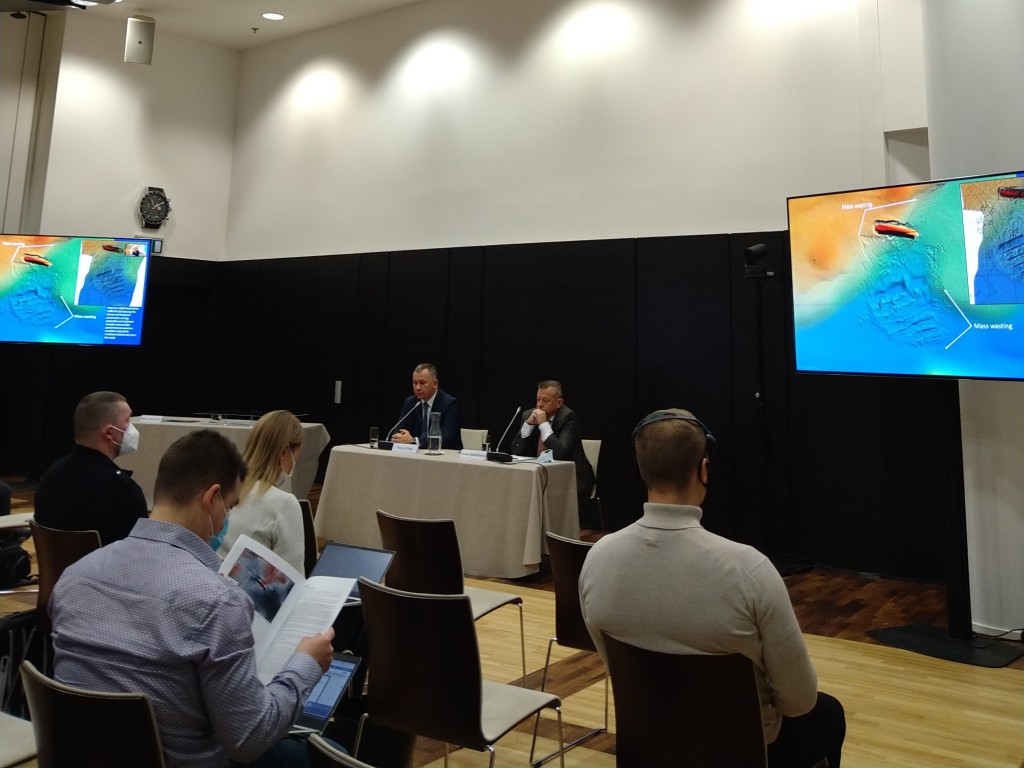
In the course of the preliminary assessment, we studied the geology of the seabed around the wreck of MV Estonia in cooperation with Stockholm University and created a bathymetric or three-dimensional image of the seabed. The Estonian Geological Survey performed a seismoacoustic profiling survey on Stockholm University’s research vessel Electra af Askö. This method enabled the team to study the cross-section of the seabed down to the hard rocks of the bedrock.
The gathered data show that the bow and stern of the wreck rest in soft clay and that the centre of the ship is lying on a ridge with a harder bedrock – probably granite. The wreck is located at a depth of 60–80 metres, while the bow and stern are situated at significantly different heights. The tilt of the wreck is 133.7 degrees, which is significantly more than the originally measured tilt.
The marine environment was studied in cooperation with Taltech. The study, which lasted more than three months, provided a more detailed overview of the currents in the different aqueous layers. The conclusions so far have been drawn on the basis of data obtained by indirect methods, and in order to draw more precise conclusions, it is necessary to study the wreck and the seabed more thoroughly by means of modern technologies.
With a 3D scanner and an underwater robot, we detected damage to the hull plating on the starboard side of the ship, which was partly shown in the film released by Discovery Networks in 2020. The damage covers an area of at least 4 metres wide and 22 metres long, but the exact extent cannot be ascertained, as the damage is partly located under the hull. The damage is on the outer plating, but also transfers to the ship's internal structures. We also found damages to the port side and stern of the wreck.
Further surveys and calculations are needed to determine the exact cause of the damage detected so far. The hinges of the vessel’s bow ramp are broken or deformed, the bow ramp itself is detached from the vessel, and the car deck is open. The following studies and analyses will also reveal what caused the bow ramp to detach from its stationary fastenings.
The work will continue for at least another year
We conducted the preliminary assessment with an international team, which included not only Estonian and Swedish marine and geological experts, but also Brian Abbot, a 3D scanner specialist from the US. We received support from Finnish, Swedish, and Estonian authorities, universities, research institutions, and companies, as well as a large number of volunteers in Hiiumaa.
Today, we have detailed information on the geology, bathymetry and aquatic environment of the seabed surrounding the wreck. We plan to conduct the main survey next spring. In the course of the main survey, we will perform a ferromagnetic survey, a laser survey and a photogrammetric survey. We will digitise the drawings of the MV Estonia, thus creating a digital ‘twin’ of the ship to perform various simulations of the shipwreck. The final summary will be completed next autumn.
Today, three quarters of the work still lies ahead of us. We are no longer at the very beginning, but it is still too early to draw significant conclusions. Regardless of the findings of the main survey, it is clear that we have new knowledge, with more to come, and that significant technological developments over the last quarter of a century will make a significant contribution to acquiring it.
The public has a right to ask questions and the nations have a duty to seek answers to these important questions. The answers must be verified, honest and factual.
The Estonia disaster has had a significant impact on maritime safety. Many of the changes to the safety rules have been driven by the aforementioned disaster and the results of its investigation. It is hoped that this will help prevent future disasters and accidents. Asking questions and finding answers when new circumstances arise will help us to better understand what happened and, indirectly, to prevent as well as minimize the risk of such accidents happening. Even if the source of these questions is the shipwreck that has caused a tremendous amount of heartache and sadness. Nothing relieves the grief of the loved ones.