
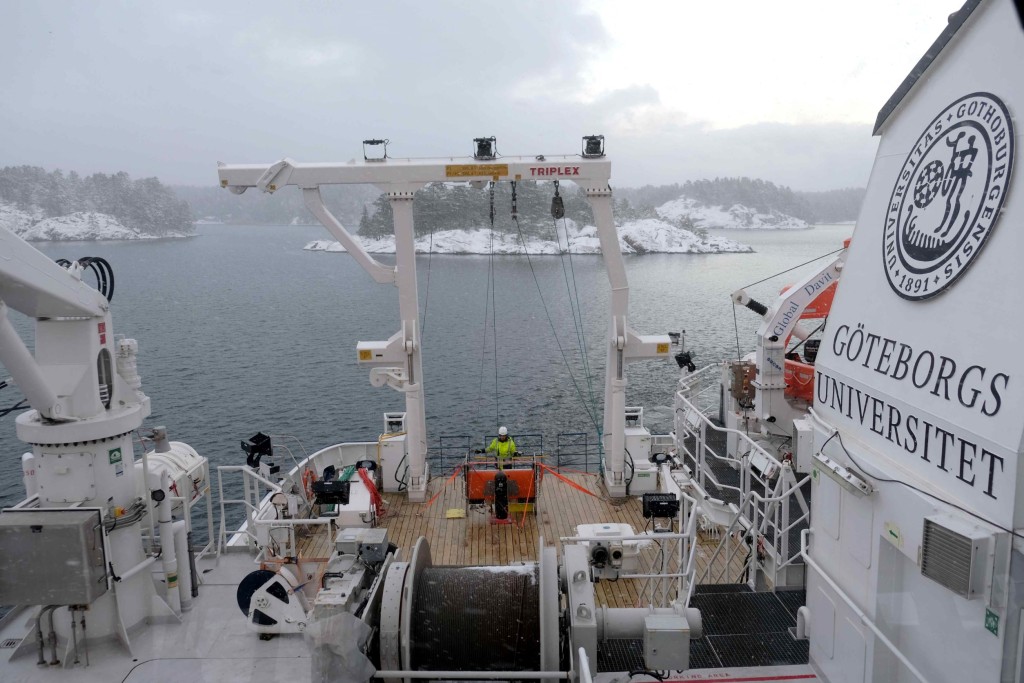
The research vessel Skagerak departed from the Swedish port of Nynäshamn on Friday, November 24 at 16:00 and arrived at the wreck site of the MV Estonia at 07:00 the following morning. The waves were awaited to settle until Saturday afternoon, after which the last on-site verification of the survey equipment began. The first part of the survey was conducted from 18:00 on Saturday evening until 11:00 on Monday morning, subject to a suitable weather window. To ensure the safety of the sonar platform launch and recovery and the quality of the data, the significant wave height had to be less than 1.5 meters on-site during the work. For waiting on weather, the research vessel Skagerak sailed up the Finnish coast to the vicinity of Lillharu island. Due to the wave limitations, the second part of the survey was started on Tuesday, November 28 at 17:00 and the work was finished early the next day at 04:00. The research vessel Skagerak arrived to Nynäshamn harbor on Wednesday, 29 November at 15:45.
The sonar survey at the wreck site of the MV Estonia was successful. In addition to the main survey area of about 4 square kilometers, high-quality data were also collected from some surrounding areas. The marine survey is followed by the analysis of the collected data on shore. The research results will be handed over to the contracting authority by the end of this year.
The purpose of the survey was to gain a better understanding of the flooded vessel's track during the accident and document the seabed around the wreck in detail. This marine survey located as many objects as possible on the seabed that relate to the vessel in the vicinity of the wreck of MV Estonia. It was expected that numerous objects entered the water column from the time the accident started, and these objects should provide the basis for a better reconstruction of the ship’s track. Results of this survey will be used as an input for the numerical flooding simulations to be carried out next year.
The survey was performed by the Norwegian contractor Reach Subsea AS which conducted the marine works at the wreck site of MV Estonia also in July this year. The vessel proposed for the project was the research vessel Skagerak owned by University of Gothenburg and operated by Northern Offshore Services.
The contractor used cutting-edge technology to receive the most precise results possible.
Survey equipment EIVA Equinox combines EIVA’s ScanFish 3D remotely operated towed vehicle (ROTV) as a platform with Wavefront’s Solstice Multi-Aperture Sonar (MAS). The MAS blends the high performance of Synthetic Aperture Sonar (SAS) with the reliability and robustness of conventional side-scan sonar (SSS). This innovative approach significantly enhances resolution compared to traditional side-scan sonar.
A sample of the resolution of the sonar image - the imprint of the bow visor of MV Estonia on the seabed.