
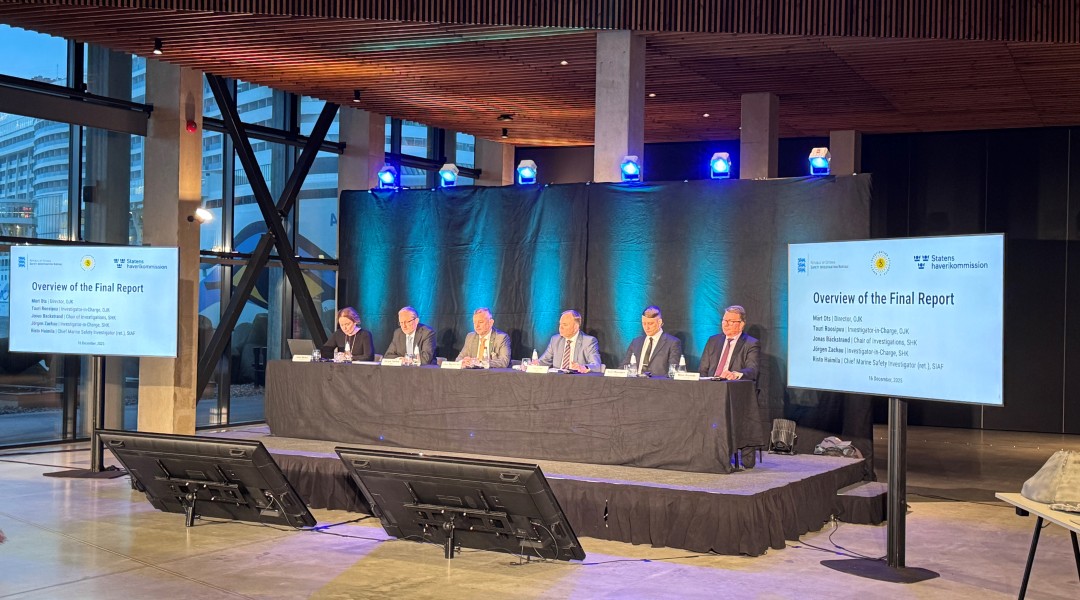
“Our work also delivers comprehensive up-to-date documentation of the wreck’s condition, the sequence of events, and the wider systemic factors that caused the accident”, states Märt Ots, director of the OJK.
The report presents a number of conclusions that draw from marine surveys, interviews with survivors, technical examinations, in addition to scientific calculations and numerical modelling.
“We have cooperated with numerous experts in different fields and have carried out six surveys at site. The seabed at site is very well documented and shows a gneiss ridge, 1.8 billion years old, almost diagonally beneath the wreck, which is almost teetering on that ridge. In combination of her resting on a slope, this is the explanation of the wreck’s large movements through the years”, says Swedish Chair, Jonas Bäckstrand, SHK.
Technical Findings
• Condition of the wreck
The wreck has significant damage and it has shifted remarkably on the seabed during the decades. The shape of the starboard-side damage corresponds well with the exposed bedrock close to it. The wreck’s condition will continue to deteriorate over time, making the occurrence of new deformations possible.
“Although the wreck covering operations in the mid-nineties have been heavily criticized, archived documents from those surveys have been valuable evidence for the PA. Based on those documents, we managed to reconstruct the wreck’s position and orientation movements on the seabed. Therefore, it is possible to demonstrate why the previously unknown damage was not visible in the nineties but was revealed later due to the wreck movement”, says Tauri Roosipuu, Investigator-In-Charge of the OJK.
• No evidence of collision or explosion
There is no indication of a collision with another vessel or object when the vessel was afloat, nor any signs of explosive force in the starboard side or the bow area.
• Bow visor and ramp failures confirmed
Examination of the recovered bow ramp and modelling of the bow structure collapse remain consistent with the 1997 JAIC findings: the bow visor failed under wave loads, causing the ramp to open and flooding to commence on the car deck.
• Sinking sequence reaffirmed
Updated modelling supports the established scenario: rapid water ingress through the bow ramp leading to capsize of the vessel. Alternative sequences, including flooding from the starboard-side opening, are incompatible with the calculations, witness statements and other collected evidence.
• Seaworthiness assessment
A combined OJK–SHK assessment states that MV ESTONIA was not seaworthy due to uninspected, thus unrecognized, structural weaknesses and undocumented regulatory exemptions on certificates.
“The vessel had latent structural deficiencies, through all her lifetime, and was technically unsafe for trade. However, this was not acknowledged among the relevant stakeholders – neither on board nor at shore”, Bäckstrand adds.
• Survivor interviews
Witness statements from 68 survivors have been collected.
“The interviews indicate that some amount of water was observed coming from the car deck to the cabin area below. They also indicate that no military vehicles were loaded. Many of the witnesses expressed their reluctance to the idea of covering the wreck. In addition, they did not understand why the bodies of the deceased were not recovered”, states Jörgen Zachau, Investigator-In-Charge of the SHK.
A Systemic Failure — Not a Single Cause
“Our Final Report emphasizes that the sinking did not result from a single root cause, nor from isolated actions by the crew. Instead, it was the outcome of a complex systemic failure within the shipping industry, combining shortcomings across. This failure was in a very disappointing way a wake-up call for the entire industry as incidents with bow visors had occurred before the accident, but knowledge of them was not spread within the industry”, stresses Roosipuu.
The chain of flaws starting from missing regulatory framework, the design and construction process of the vessel, lacking inspection and anomalies in certification combined with the working practice of the shipping industry (safety culture) created a situation in which the accident was nearly impossible to halt once the initial failures began.
The Final Report notes that public discussions have often focused on individual factors, such as ship speed or maintenance standards. The PA clarifies that these factors cannot explain the sinking alone; the disaster resulted from an accumulation of systemic weaknesses and insufficient risk management throughout the sector.
Lessons Learned
As regrettable as the MV ESTONIA disaster was, it led to drafting and implementing of new common rules, especially related to bow structure and vessel stability, reinforcement of the existing ships and developing the life-saving appliances. More than three decades of safe passenger ferry operations after the accident in the Nordic-Baltic area have proven that valuable lessons were learned from the accident that allowed to improve maritime safety.
Final Conclusions
Based on all available evidence, it can be concluded that MV ESTONIA sank due to the failure of the bow structure, and that the new damage on the starboard side resulted from contact with the seabed. Therefore, there is no need to reopen the safety investigation of the accident of MV ESTONIA.