
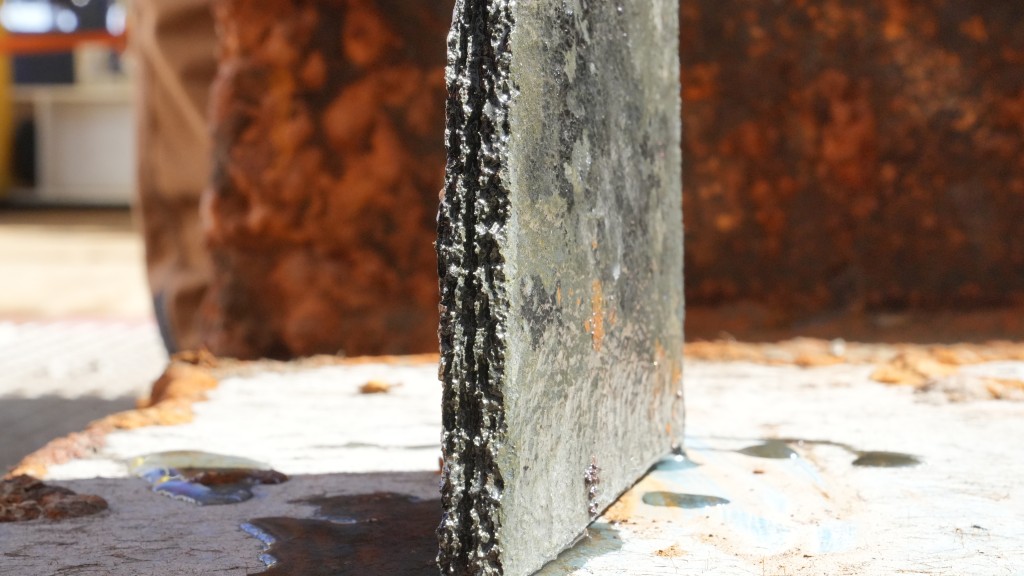
Three reports from the Estonian Forensic Science Institute cover different aspects of the analyses of the steel sample cut from the edge of the forward starboard side damage of the wreck and the bow ramp recovered in July 2023.
The first report concludes that no traces of contact or collision with a metal object were found on the steel sample submitted for examination.
The second report concludes that no traces of explosives were found from the steel sample submitted for examination.
The third report concludes that no characteristic signs of explosion were found on the presented objects (steel sample and bow ramp), photos or videos (ROV videos of the starboard side damage, car deck and bow area) by visual examination.
The bow ramp of MV Estonia was recovered from the seabed in July 2023. A digital twin of the ramp was created. The bow ramp was laser scanned and a photo-textured 3D model was created by applying a photogrammetric mosaic onto the surface of the 3D model.
Two steel cutouts from 1994 were recovered from the wreck in July 2023. The mechanical properties of the two steel plates were determined in deformation tests at the Tallinn University of Technology. There is a discrepancy between the material curves obtained in the tests and the material curves used in the numerical assessment of the bottom impact of MV Estonia. The results indicate that the recovered material is stronger than the properties used in the simulations of the bottom impact presented in September 2023. This difference may have affected the results of the simulations. Therefore, the Tallinn University of Technology recommends that the numerical assessment of the bottom impact be repeated with new material curves.
A sample from an outcropping bedrock from the vicinity of the forward damage of the wreck was collected in July 2023. A chip of this sample was cut by Vancouver Petrographics and the petrographic analyze was carried out by the Stockholm University. The report from the Stockholm University concludes that the sample is almost certainly gneiss. This is a very common bedrock in Finland, Sweden and Norway.
On behalf of the Swedish Accident Investigation Authority (SHK) a visual examination of the salvaged bow ramp has been carried out on site in Estonia by Element Materials Technology.
The main purpose of the examination was to match the appearance and damage of the bow ramp with the event description according to the technical report: " MV ESTONIA Bow arrangement collapse - Sequence of events”. Gothenburg, November 2007, Jan-Ove Carlsson
Nothing has been found in the review/investigation on site that contradicts the description of the sequence of events described in the documentation, except that the ramp locking hooks are assessed to have been latched at the time of the accident.
The separation of the railing most likely occurred as a part of the accident.
No evidence is noted suggesting that the bow ramp, or the railings has been separated from the hull by machine tools or thermal cutting.
The Swedish Accident Investigation Authority (SHK) requested an investigation of material deposited on the hull of the MS Estonia shipwreck present at the forward hole on the starboard side.
Material deposited in 13 locations close to the fracture was analyzed in terms of element content, microbial community composition, mineralogy, and particle morphology. A piece of steel, cut out from the sampled area, was also analyzed for reference purposes.
In conclusion, this study indicates that the deposits associated with the hole on the starboard side of the MS Estonia are the result of natural processes, including biofouling (microorganism accumulation on the steel surface), siliciclastic sediment incorporation, and natural corrosion of exposed steel. The predominantly black appearance of the corrosion layer is attributed to the documented dysoxic conditions at the seabed, favoring the formation of darker minerals like green rust and iron sulfides.